Uneven tone, darker patches on the cheeks or forehead, a shadow left by a blemish that will not fade for months: pigmentation on the face is one of the most common reasons people ask a beauty therapist or dermatologist for advice.
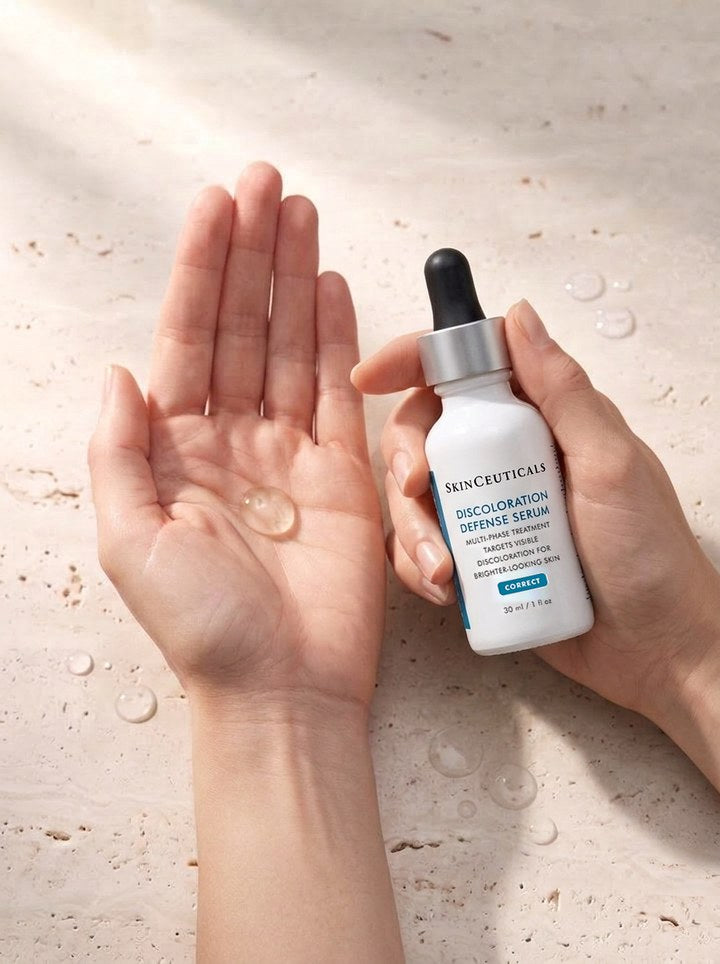
Honesty first: dark spots do not disappear overnight, and no product removes them for good. What is realistic, with consistent care, the right actives and above all daily sun protection, is spots that look visibly lighter and a more even-looking complexion over several months. This guide explains why pigmentation appears, which three pillars of care make a difference, and when a spot belongs with a doctor rather than in a serum. Dedicated options for dark spots, such as Discoloration Defense Serum, now exist as well, and we come to them below.
The short answer
A routine for dark spots and uneven tone usually combines three roles: a vitamin C antioxidant serum in the morning, a targeted serum for dark spots and a broad-spectrum sunscreen every day. Phloretin CF is the morning antioxidant for normal, oily and combination skin; C E Ferulic suits dry, normal and sensitive skin. Discoloration Defense is the targeted step: according to the manufacturer, it is used twice a day, in the morning after the vitamin C serum and before sunscreen. Any spot that changes, or that you are unsure about, should be checked by a dermatologist.
What pigmentation is and how melanin forms
Skin colour depends on melanin, a pigment made by cells called melanocytes. When skin meets a trigger, most often UV radiation but also inflammation, injury or hormonal change, the melanocytes respond with extra melanin as a kind of defence. The pigment sometimes spreads unevenly, which leaves darker spots or an overall uneven tone.
The most common causes of pigmentation on the face
Sun and UV radiation
UV radiation is the main trigger of hyperpigmentation, and the reason spots tend to deepen in summer and fade in winter. Unprotected sun exposure can prompt the melanocytes to make more pigment, so existing spots can darken and new ones can form.
Post-blemish marks (PIH)
Post-inflammatory hyperpigmentation (PIH) appears when skin leaves a darker mark after inflammation, usually a pimple, but also an injury or aggressive pore cleaning. These marks can last for months because skin responds slowly, and more sun exposure sets them in and lengthens the time they need to fade.
Hormonal changes and melasma
Hormonal shifts such as pregnancy, hormonal contraception or changes in oestrogen levels can encourage melasma, a form of pigmentation that typically shows up as symmetrical patches on the cheeks, forehead or upper lip. Melasma is often more persistent than ordinary sun-related pigmentation, so a dermatologist's assessment is advisable.
Ageing and age spots
Over the years the number and activity of melanocytes change, while skin collects decades of sun exposure. The result is age spots (lentigines): flat, brownish patches that appear mostly on the face, hands and décolleté.
Three pillars for a more even-looking complexion
Care for a more even-looking complexion rests on three pillars that work together: antioxidants by day, targeted care and daily sun protection.
Antioxidants by day
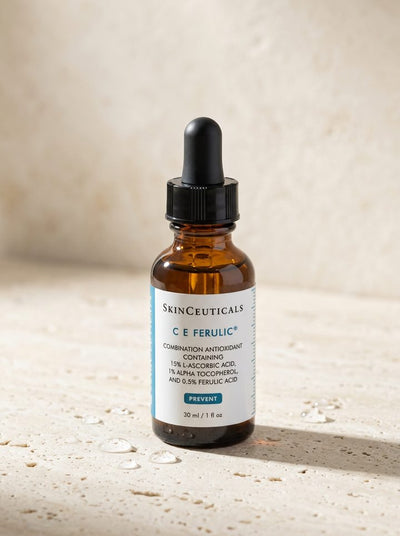
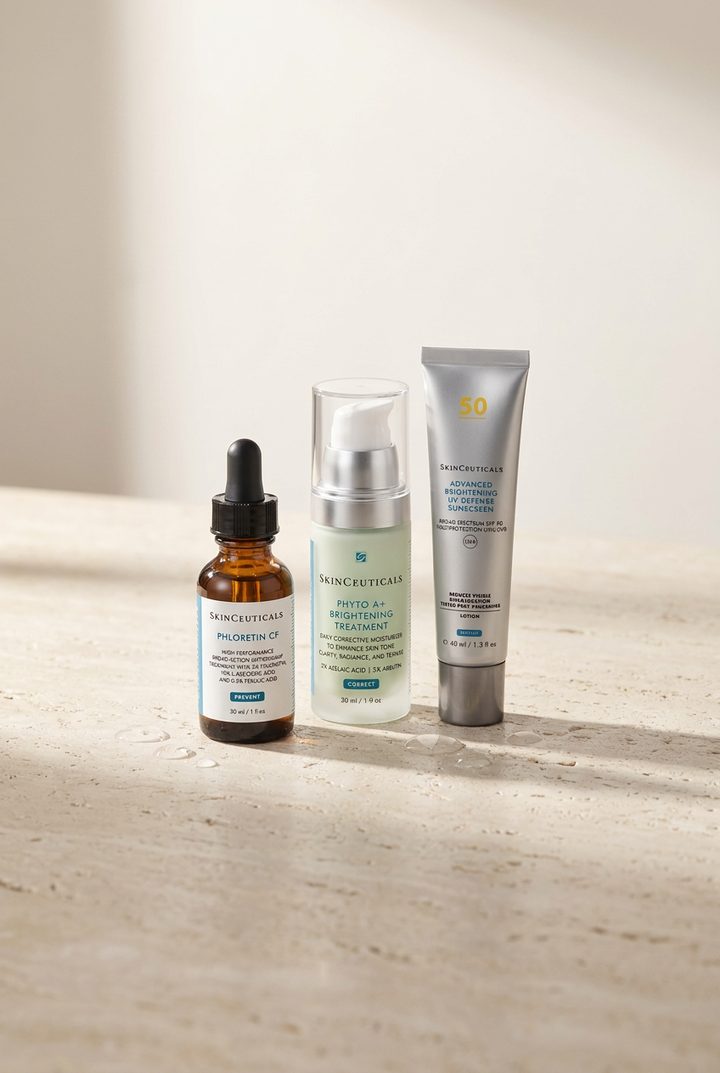
Antioxidants help protect skin from free radicals created by UV and pollution. Phloretin CF combines 2% phloretin, 10% pure vitamin C and 0.5% ferulic acid and, according to the manufacturer, helps reduce the look of discolouration and uneven tone; it suits normal, oily and combination skin. Silymarin CF is an oil-free vitamin C serum with 15% pure vitamin C, 0.5% silymarin, 0.5% ferulic acid and 0.5% salicylic acid for normal, oily and combination skin that is prone to blemishes. C E Ferulic combines 15% pure vitamin C with 1% vitamin E and 0.5% ferulic acid and suits dry, normal, combination and sensitive skin. For the serum you choose, apply 4 to 5 drops in the morning after cleansing to dry skin, before subsequent skincare and sunscreen.
Targeted care for dark spots and texture
Discoloration Defense Serum is a corrective serum for the appearance of dark spots, post-blemish marks and uneven tone. Its key ingredients are tranexamic acid, niacinamide and HEPES. The manufacturer recommends it for dry, normal, oily, combination and sensitive skin. Apply 3 to 5 drops twice a day; in the morning, after a vitamin C serum and before broad-spectrum SPF 50. Do not apply to broken or irritated skin. In study A, 50 women aged 25 to 60 with Fitzpatrick skin types I to IV used it twice daily with sunscreen for 12 weeks. The appearance of stubborn brown spots improved by an average of 60%. In a separate study B, 51 women with Fitzpatrick skin types V to VI used it twice daily with sunscreen for 12 weeks; the appearance of post-inflammatory marks improved by an average of 34%. These are average results in different groups, not a guarantee for an individual. Manufacturer study details.
For texture, Retexturing Activator is an oil-free serum that combines surface exfoliation with hydration; according to the manufacturer, it helps skin look smoother and more radiant, with fewer visible surface lines (4 to 6 drops, twice a day). Phyto A+ Brightening Treatment is a light gel-cream with 3% azelaic acid and 2% alpha arbutin for dry, normal, oily, combination and sensitive skin; according to the manufacturer, it helps reduce the look of redness, excess oil and post-blemish discolouration (1 to 2 pumps twice a day, followed by sunscreen in the morning).
Sun protection: the step that protects the progress
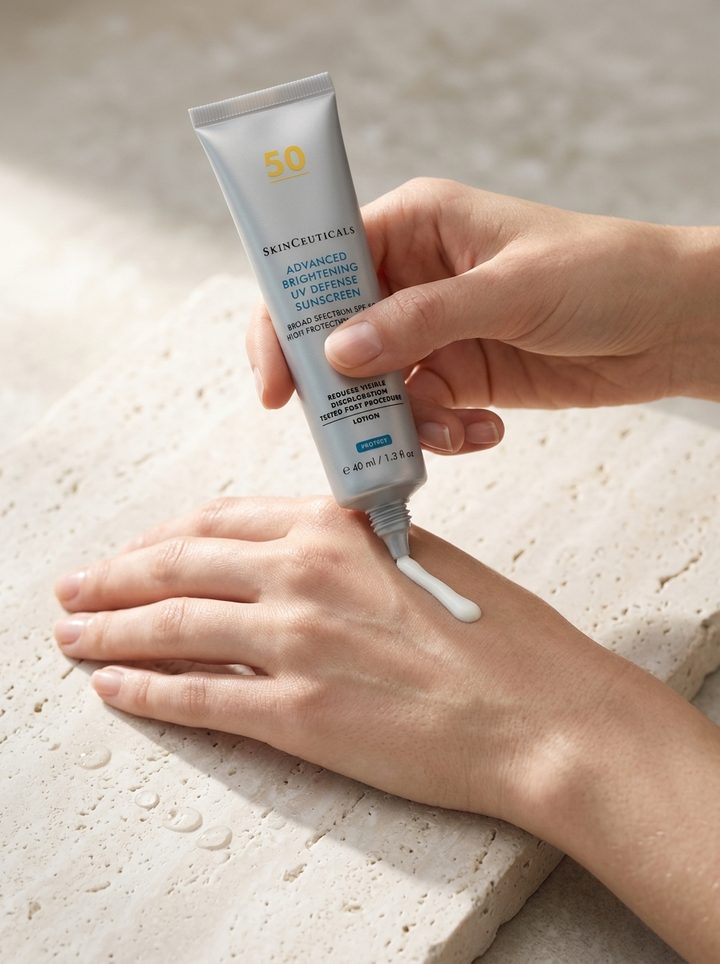
UV exposure can trigger dark spots or make existing ones look darker. Daily sun protection helps limit further UV exposure. Advanced Brightening UV Defense SPF 50 provides broad-spectrum UVA and UVB protection and, according to the manufacturer, helps reduce the appearance of existing discolouration. Ultra Facial UV Defense SPF 50+ has a very light texture and can be used as a make-up base. Apply generously before sun exposure and make-up, following the instructions for your chosen product. Reapply as directed on the pack, especially after swimming, sweating or towelling.
Phloretin CF or Discoloration Defense: which to choose for dark spots?
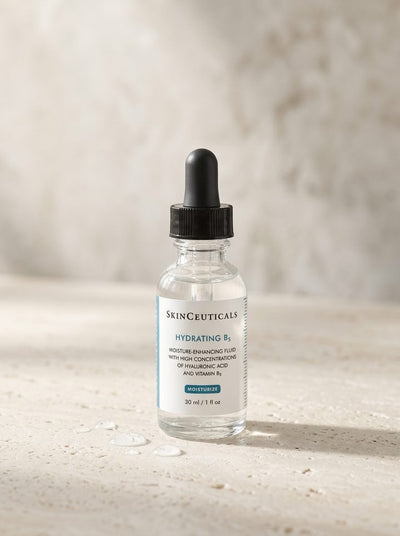
The two serums do not replace each other: they are two different steps. Phloretin CF is a morning antioxidant serum with vitamin C; Discoloration Defense is a targeted serum for the look of dark spots that can follow it in the same routine. If you want only one step, choose by your main goal: an overall more even, radiant-looking tone with antioxidant care (Phloretin CF), or visible dark spots and post-blemish marks (Discoloration Defense).
| Property | Phloretin CF | Discoloration Defense |
|---|---|---|
| Role | morning antioxidant serum with vitamin C | targeted corrective serum for dark spots |
| Key ingredients (manufacturer) | 2% phloretin, 10% pure vitamin C (L-ascorbic acid), 0.5% ferulic acid | tranexamic acid, 5% niacinamide, 5% HEPES |
| Skin type (manufacturer) | normal, oily and combination skin | dry, normal, oily, combination and sensitive skin |
| How to use | 4 to 5 drops once a day in the morning, before other care, then sunscreen | 3 to 5 drops twice a day; in the morning after the vitamin C serum, before sunscreen |
| Study evidence | Separate studies; see the conditions below. | Separate studies; see the conditions above. |
In a 12-week study reported by the manufacturer, 64 women aged 25 to 60 with Fitzpatrick skin types I to VI used Phloretin CF each morning with sunscreen and moisturiser if needed. Researchers assessed an average 20% improvement in the evenness of skin tone and 16% improvement in the appearance of discolouration. Individual results vary. Manufacturer study details These separate studies used different groups and endpoints. Their percentages cannot establish which serum is more effective.
A sample routine, step by step
Morning
- Cleanse with a mild cleanser suited to your skin type.
- Antioxidant serum: Phloretin CF, Silymarin CF or C E Ferulic, depending on your skin type.
- Discoloration Defense Serum, for dark spots and post-blemish marks.
- Moisturiser suited to your skin type.
- Sunscreen, every day without exception.
Evening
- Cleanse your skin after the day.
- Discoloration Defense Serum (the clinical study used it twice daily).
- If texture is also a concern, Retexturing Activator or Phyto A+ Brightening Treatment.
Follow the manufacturer’s directions for each product and observe how your skin responds. If your skin is also blemish-prone, Blemish + Age Defense is an oil-free serum with salicylic acid for combination, oily and blemish-prone skin; according to the manufacturer, it helps reduce the look of blemishes, uneven tone and fine lines (4 to 5 drops once or twice a day, in the morning after vitamin C and before sunscreen).
How long until you see results
Realistic expectations matter. According to the manufacturer, skin tone can look more even after two weeks with Discoloration Defense; with Phloretin CF, first results show after four to six weeks and clearer ones after twelve. Stubborn or deeper pigmentation can take longer, and results vary from person to person. What helps most is consistency: a daily antioxidant, targeted care and sunscreen every day.
When to see a dermatologist
Cosmetic care can visibly brighten the complexion, but it does not replace a medical diagnosis. See a dermatologist if a spot suddenly changes in colour, shape or size, if it bleeds, itches or looks suspicious, or if you have persistent melasma that does not respond to cosmetic care.
Frequently asked questions
Does vitamin C help with dark spots?
Vitamin C is an antioxidant. Serums that contain pure vitamin C, such as Phloretin CF and C E Ferulic, help brighten and even out skin tone when used every morning under SPF.
Can I use brightening care in summer?
Yes, with one essential condition: consistent SPF. Some actives can make skin more sensitive to the sun, so UV protection matters even more in summer.
Do marks left by breakouts fade on their own?
How quickly marks fade differs from person to person. Daily sun protection helps keep them from looking darker. Discoloration Defense Serum is designed to reduce the look of post-blemish marks (see the study details above), and Blemish + Age Defense is made for blemish-prone skin. If a mark changes or you are unsure what it is, ask a dermatologist.
What is the difference between sun-related pigmentation and melasma?
Sun-related pigmentation, such as freckles and age spots, appears directly in response to UV and usually responds well to cosmetic care and SPF. Melasma is hormone-related, often symmetrical and more persistent, so a dermatologist's assessment is advisable before starting more intensive care.
Find the right care for your skin
An even-looking complexion builds with patience, step by step: the right antioxidants, targeted care and consistent sun protection. Skin2Glow is an authorized SkinCeuticals retailer, with expert guidance from Nataša Recek in Vienna. Explore the products above and find the combination that suits your skin.
- Free shipping on orders of €95 or more
- Free tester on orders over €100
- Free gift of your choice on orders over €200